

Responding to the Top 10 Common Criticisms of Tulum
First and foremost, who am I, and what qualifies me to write this article about Tulum? I prefer to clarify this in the introduction because even though I strive for objectivity, this article will tend to defend Tulum against its accusers.
I am a Frenchman living in Mexico and have been working in the tourism industry for over 15 years. Throughout this period, I have visited Tulum several times a year. Hence, I have been able to witness the transformation of this small hippie village into a truly “Instagrammable” eco-chic city. Considering myself somewhat of a witness, I grant myself the authority to take a stance.
I am a Frenchman living in Mexico and have been working in the tourism industry for over 15 years. Throughout this period, I have visited Tulum several times a year. Hence, I have been able to witness the transformation of this small hippie village into a truly “Instagrammable” eco-chic city. Considering myself somewhat of a witness, I grant myself the authority to take a stance.
So, Tulum or not Tulum ? That’s is the question.
If you research Tulum, especially on social media, you’ll find conflicting opinions. More importantly, you’ll notice that this town leaves no one indifferent. So why is it so challenging to grasp Tulum from the outside? And, most importantly, why are all the opinions so polarized, with such extreme positions taken? In other words, why does Tulum either enchant or infuriate? We will attempt to answer these questions as objectively as possible so that, by the end of this article, you can determine if this destination is suitable for your travels.
We will dissect one by one the complaints of travelers on vacation in Tulum. Here are the ones that come up most frequently:
“Tulum is the opposite of ecological.”
“Tulum is not Mexico.”
“Tulum is mass tourism.”
“Tulum is very expensive.”
“Tourism constructions in Tulum are destroying the jungle.”
“The beach is too far from the town.”
“Tulum was better before.”
“No access to the beaches.”
“There are no free beaches; beach clubs are everywhere.”
“In Tulum, beach clubs overstep by imposing minimum consumption requirements.”
Let’s explore these criticisms one at a time, aiming to provide you with a comprehensive and unbiased view so that you can make an informed decision about whether Tulum aligns with your travel preferences.
We will dissect one by one the complaints of travelers on vacation in Tulum. Here are the ones that come up most frequently:
“Tulum is the opposite of ecological.”
“Tulum is not Mexico.”
“Tulum is mass tourism.”
“Tulum is very expensive.”
“Tourism constructions in Tulum are destroying the jungle.”
“The beach is too far from the town.”
“Tulum was better before.”
“No access to the beaches.”
“There are no free beaches; beach clubs are everywhere.”
“In Tulum, beach clubs overstep by imposing minimum consumption requirements.”
Let’s explore these criticisms one at a time, aiming to provide you with a comprehensive and unbiased view so that you can make an informed decision about whether Tulum aligns with your travel preferences.
1 "Tulum is the opposite of ecological."

This is the first major paradox of Tulum. Indeed, everyone talks about ecology and nature conservation from morning till night, but it’s just an ambiance, a philosophy. For instance, one out of every two residents among the 50,000 living in Tulum took a plane to settle here. The true locals, those who come from two generations of Tulum residents, are a minority. The majority of people who created all these “ecological” businesses arrived by plane or even live elsewhere. Moreover, in the very principle of creating an ecological business to attract international tourists, you’ll agree that something is amiss…
One point for the genuine environmentalists because the criticism is valid. Tulum draws inspiration from ecology: yes. Is it populated by ecologists: probably. Does it play the ecological card to exist: absolutely. But Tulum is anything but an ecological town. Real environmental activists would be appalled. Just so you know, all the hotels located on the waterfront don’t have running water. These same hotels that provide you with ecological cosmetics and paper straws for your beachside juice use tanker trucks to fill your toilets with fresh water. So, if you want to reduce your ecological footprint, it’s better to stay closer to downtown or in the jungle areas nearby, where fresh water is naturally available.
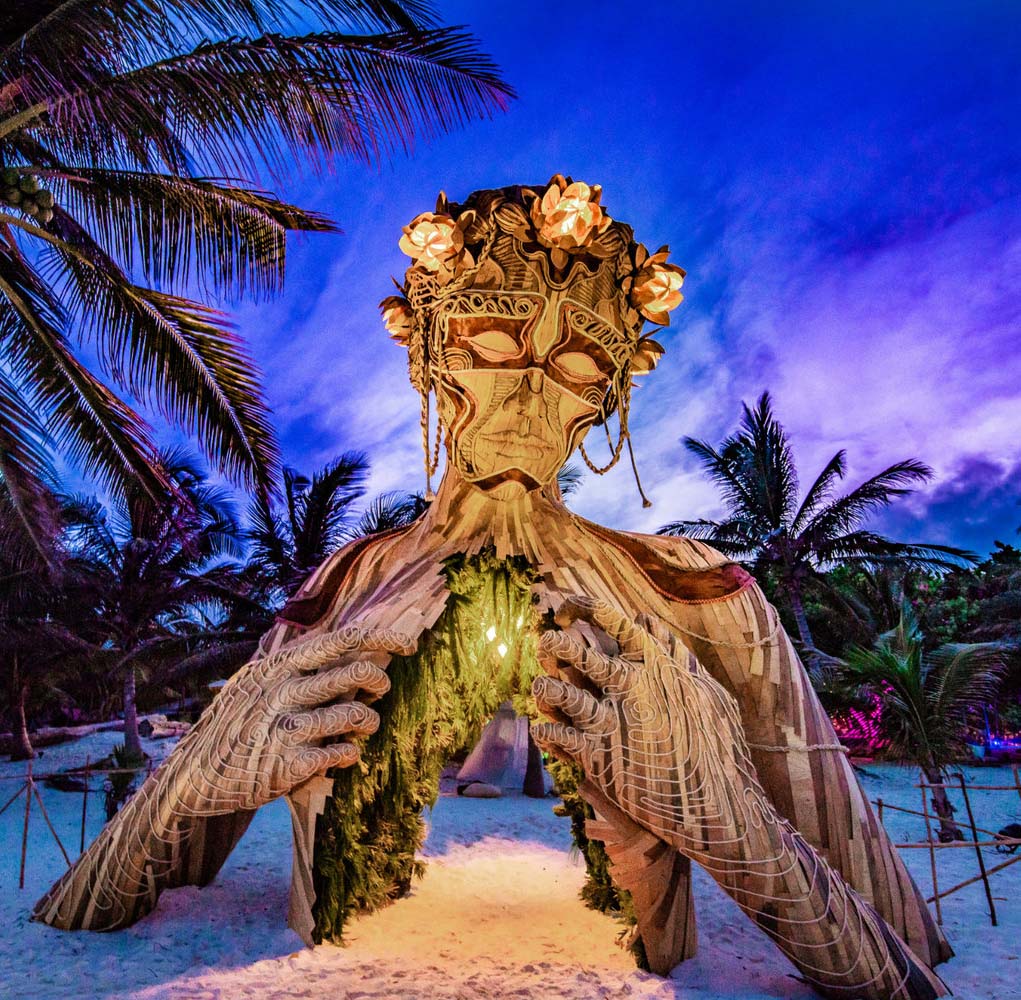
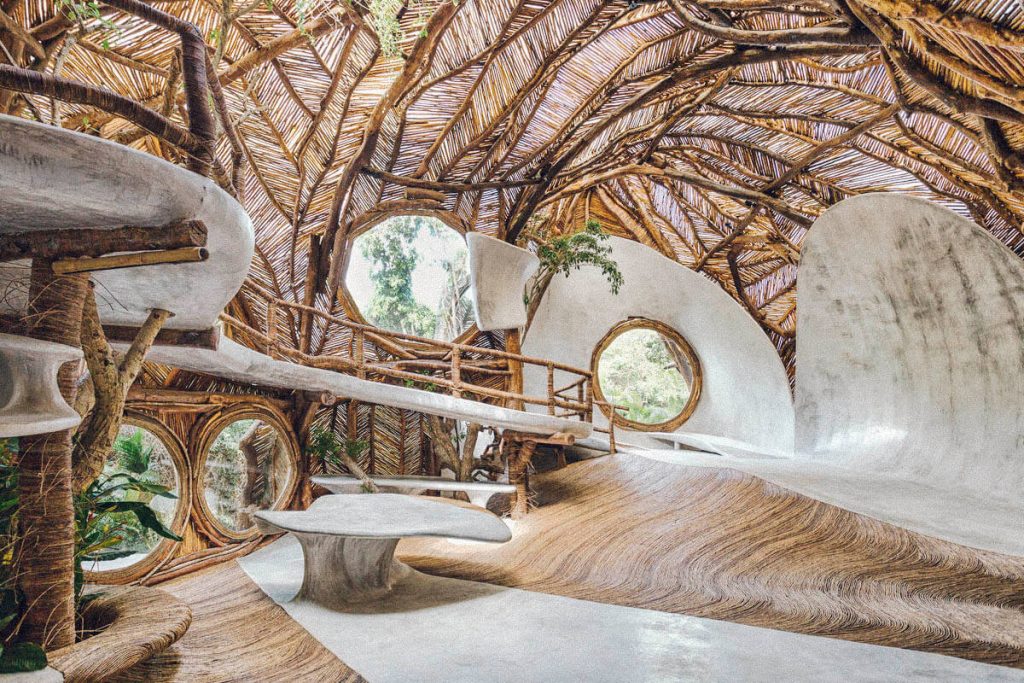
In the end, you’ll understand that ecology in Tulum is primarily an identity, a visual ambiance, and a construction theme. It’s good to know this beforehand. In fact, you’ll never see a town where the shops are so original and beautifully decorated with exotic wood. Some will say it’s an inspiring town with a genuinely unique cultural identity, and that’s true. Others will say it’s Disneyland and not Mexico. They probably chose the wrong destination and will spend their precious time in Tulum pointing out and pondering the city’s ecological inconsistencies. More power to them, but it would have been wiser to do their research beforehand!
One point for the genuine environmentalists because the criticism is valid. Tulum draws inspiration from ecology: yes. Is it populated by ecologists: probably. Does it play the ecological card to exist: absolutely. But Tulum is anything but an ecological town. Real environmental activists would be appalled. Just so you know, all the hotels located on the waterfront don’t have running water. These same hotels that provide you with ecological cosmetics and paper straws for your beachside juice use tanker trucks to fill your toilets with fresh water. So, if you want to reduce your ecological footprint, it’s better to stay closer to downtown or in the jungle areas nearby, where fresh water is naturally available.
In the end, you’ll understand that ecology in Tulum is primarily an identity, a visual ambiance, and a construction theme. It’s good to know this beforehand. In fact, you’ll never see a town where the shops are so original and beautifully decorated with exotic wood. Some will say it’s an inspiring town with a genuinely unique cultural identity, and that’s true. Others will say it’s Disneyland and not Mexico. They probably chose the wrong destination and will spend their precious time in Tulum pointing out and pondering the city’s ecological inconsistencies. More power to them, but it would have been wiser to do their research beforehand!
2 "Tulum is not Mexico."

Often, this remark is linked to the high proportion of foreign tourists you encounter on the streets of Tulum. Tourists who are surprised to find themselves in the most touristy region of the country. I am always astonished to hear this statement from someone who has just spent two weeks on vacation when I, as a tour guide who knows almost every corner of the country, still find it challenging to define exactly what Mexico is. It’s a bit like if a Mexican came to spend a week on the French Riviera and said, “Saint Tropez, this isn’t Europe.” Let’s put things in perspective: Mexico is vast, diverse, multicultural, multi-ethnic, multilingual, and has various climates. It’s almost as large as Europe. Are the skyscrapers of Paseo Reforma in Mexico City any less Mexican than the blue agave fields in the state of Jalisco?
Ultimately, it seems that people who hold such views came to Mexico to see something very specific and refuse to accept any other reality. Perhaps they only wanted to see jungle, animals, and the huts of poor people? Would they feel more adventurous that way? How about little Mexicans taking naps all day in the shade of a donkey? Indeed, rather than being surprised by a new reality and embracing this perspective, these “critics” prefer to dismiss it, claiming that it doesn’t align with the country they came to visit.
On the contrary, it seems to me that Tulum is so much Mexico! It’s vibrant, multicultural, welcoming, colorful, original, festive, the food is delicious, you find a surprise at every corner, and it’s even a bit crazy at times. You encounter rich people, poor people, and people of all colors. One thing is certain: Tulum is unique and singular, exactly like Mexico.
Ultimately, it seems that people who hold such views came to Mexico to see something very specific and refuse to accept any other reality. Perhaps they only wanted to see jungle, animals, and the huts of poor people? Would they feel more adventurous that way? How about little Mexicans taking naps all day in the shade of a donkey? Indeed, rather than being surprised by a new reality and embracing this perspective, these “critics” prefer to dismiss it, claiming that it doesn’t align with the country they came to visit.
On the contrary, it seems to me that Tulum is so much Mexico! It’s vibrant, multicultural, welcoming, colorful, original, festive, the food is delicious, you find a surprise at every corner, and it’s even a bit crazy at times. You encounter rich people, poor people, and people of all colors. One thing is certain: Tulum is unique and singular, exactly like Mexico.
3 "Tulum is mass tourism."
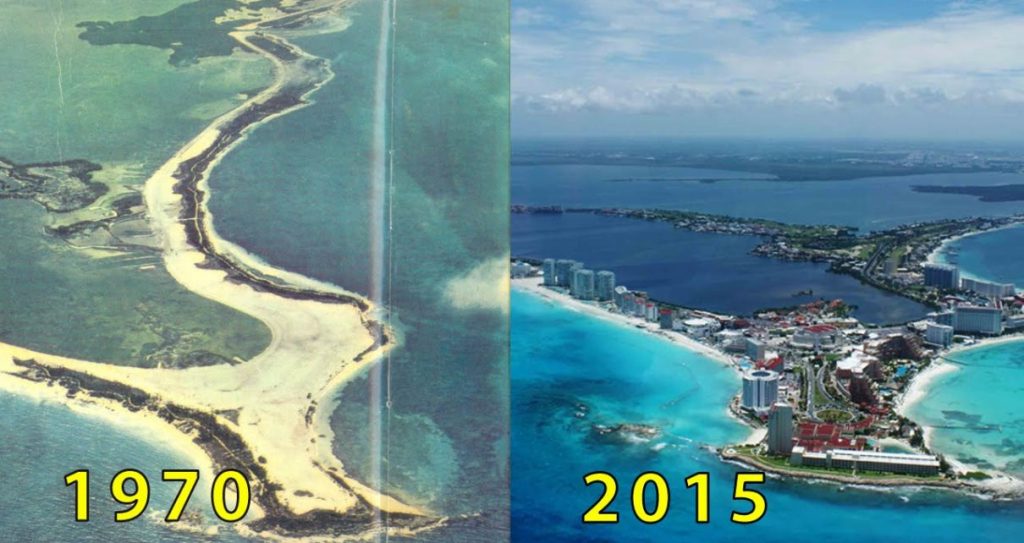
Let’s rewind a bit to the late 1960s when the Mexican authorities decided to create Cancun literally from scratch. It was meant to be a counterbalance to the resort town of Acapulco, which at the time primarily attracted wealthy domestic tourists from Mexico City. Acapulco, situated on the Atlantic coast of the state of Guerrero, was accessible within a 5-hour drive. So why, in 1969, did President Diaz Ordaz sign off on the creation of the country’s future tourist hub, situated 28 hours away from Mexico City? The answer is simple: thanks to the rise of air travel in the 1970s and the exponential growth of the northeastern United States. It made more sense for the Mexican authorities to urbanize a completely new area to cater to the very specific needs of the North American market rather than saturating Mexico’s only major resort town with foreign tourists. It’s worth noting that American tourists have always preferred to maintain their consumption habits when they travel. Thus, Cancun was born in 1970 with the aim of attracting the weary workforce from the cold winters of the northern United States. Cities like New York, Washington, Boston, Detroit, Chicago, Pittsburgh, and Philadelphia are all within a 4-hour flight of Cancun. A successful recipe was concocted, transforming a narrow strip of sand, only 20 meters wide but more than 30 kilometers long, to accommodate some of the world’s largest hotels: the famous “resorts.” They all offered comfort and were situated on sandy beaches facing the turquoise sea. A winning combination.
So why do I mention Cancun, you may ask? Well, precisely because Tulum used the construction wave of Cancun to develop in its opposite direction. Faced with Cancun’s urbanization, Tulum immediately focused on nature. While Cancun attracted American workers, Tulum chose hippies and European travelers (remember, Woodstock was only two years prior). And most importantly, in contrast to the huge concrete tourist complexes, Tulum built its eco-friendly huts in the jungle and facing the sea. Tulum has, in fact, been an alternative to mass tourism in the region—a kind of village of die-hards. It was this stance 50 years ago that gives it legitimacy today, an identity it still fiercely claims. Once, Americans stayed in Cancun while Europeans spent a few days in Tulum as part of an itinerant trip. This is still the case, but the proportions tend to blur.
However, times are changing, and so are tourists’ expectations. We seem to have entered an era where individuality takes precedence over mass experiences. It’s a period where it’s better to discover the latest trendy boutique hotel than to stay in the soulless mega-resort that everyone already knows. For about a decade now, all international spotlights have been on Tulum, its energy, and its alternative culture. Social media has played a significant role too. It’s a destination that still sees itself as an original and ecological alternative to Cancun. Whether we like it or not, Tulum has become the capital of “eco-chic” in Mexico, and its decorative style, the so-called “Tuluminati,” is captivating. So, fortunately for some and unfortunately for others, yes, tourists are increasingly flocking there! Even though Tulum is no longer the small fishing village some people miss, accusing it of mass tourism is really doing it a disservice.
So why do I mention Cancun, you may ask? Well, precisely because Tulum used the construction wave of Cancun to develop in its opposite direction. Faced with Cancun’s urbanization, Tulum immediately focused on nature. While Cancun attracted American workers, Tulum chose hippies and European travelers (remember, Woodstock was only two years prior). And most importantly, in contrast to the huge concrete tourist complexes, Tulum built its eco-friendly huts in the jungle and facing the sea. Tulum has, in fact, been an alternative to mass tourism in the region—a kind of village of die-hards. It was this stance 50 years ago that gives it legitimacy today, an identity it still fiercely claims. Once, Americans stayed in Cancun while Europeans spent a few days in Tulum as part of an itinerant trip. This is still the case, but the proportions tend to blur.
However, times are changing, and so are tourists’ expectations. We seem to have entered an era where individuality takes precedence over mass experiences. It’s a period where it’s better to discover the latest trendy boutique hotel than to stay in the soulless mega-resort that everyone already knows. For about a decade now, all international spotlights have been on Tulum, its energy, and its alternative culture. Social media has played a significant role too. It’s a destination that still sees itself as an original and ecological alternative to Cancun. Whether we like it or not, Tulum has become the capital of “eco-chic” in Mexico, and its decorative style, the so-called “Tuluminati,” is captivating. So, fortunately for some and unfortunately for others, yes, tourists are increasingly flocking there! Even though Tulum is no longer the small fishing village some people miss, accusing it of mass tourism is really doing it a disservice.
4 "Tulum is very expensive."
This is another complaint frequently voiced by Europeans. On one hand, it seems that Europeans tend to travel more as nomads, so they are acutely aware that Tulum is pricier than the rest of the Yucatan. On the other hand, Americans often come to settle in Tulum for one or two weeks, and as they have fewer vacation days, their budgets for fun activities are more substantial. Tulum’s prices don’t seem to bother them at all; in fact, quite the opposite.
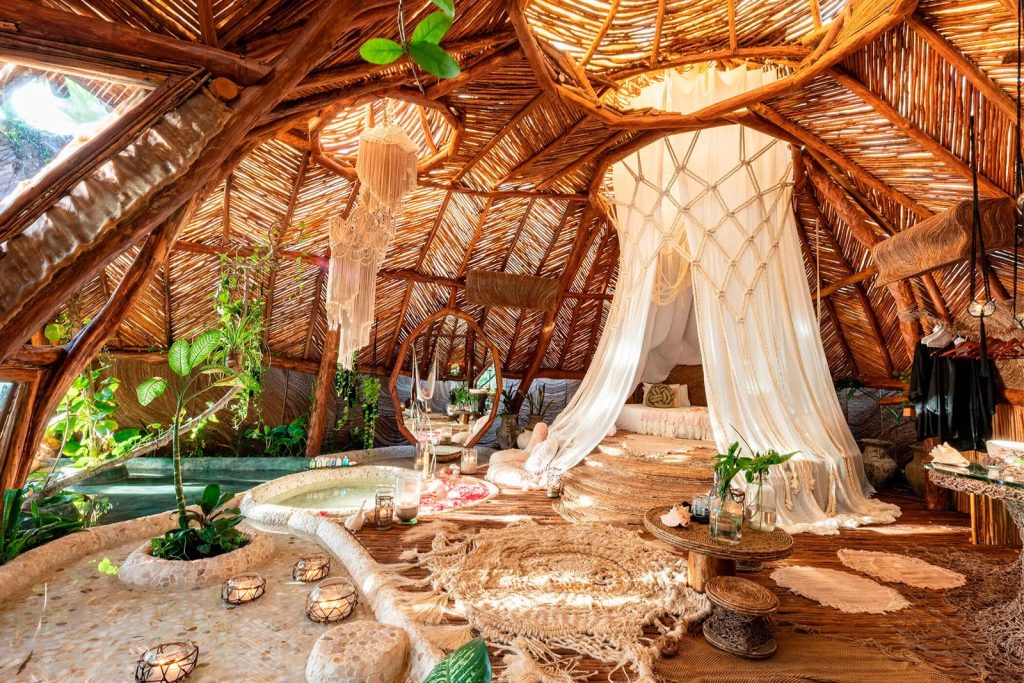
But let’s put things into perspective: Tulum is the Saint-Tropez of Mexico, and tourists expect to dine for two euros as they might in Asia? That’s not realistic. To give you an idea of expenses, staying in Tulum for a few days would cost about as much as staying in an average French town. Admittedly, it must be acknowledged that hotels with sea views are truly exorbitant. So yes, Tulum is more expensive than the rest of the Yucatan Peninsula, and yes, there are a few tourist traps, but in absolute terms, Tulum cannot be considered a costly city. Paris, Moscow, London, New York—those are expensive cities. Imagine renting a 100m2 penthouse for 4 people with a pool in Paris. In Tulum, you can find such accommodations for between 50 and 150 euros per night, depending on the season. The concentration of boutique hotels and extraordinary Airbnb accommodations is exceptional. Try finding a similar place elsewhere on the globe. The city boasts an astonishing array of excellent restaurants where you can eat for less than 25 euros. Moreover, countless establishments are open 24/7. When it comes to nightlife, Tulum parties 7 days a week, all year round. One could even say that Tulum has been a perpetual party for over 20 years. Americans will say it’s not an expensive city given everything it offers above and beyond Cancun. Europeans, often more financially constrained, may be outraged that the city is pricier than other villages in the Yucatan they visited and might prefer the prices of Merida. Everyone has their own perspective, and most importantly, everyone has their own budget.
But let’s put things into perspective: Tulum is the Saint-Tropez of Mexico, and tourists expect to dine for two euros as they might in Asia? That’s not realistic. To give you an idea of expenses, staying in Tulum for a few days would cost about as much as staying in an average French town. Admittedly, it must be acknowledged that hotels with sea views are truly exorbitant. So yes, Tulum is more expensive than the rest of the Yucatan Peninsula, and yes, there are a few tourist traps, but in absolute terms, Tulum cannot be considered a costly city. Paris, Moscow, London, New York—those are expensive cities. Imagine renting a 100m2 penthouse for 4 people with a pool in Paris. In Tulum, you can find such accommodations for between 50 and 150 euros per night, depending on the season. The concentration of boutique hotels and extraordinary Airbnb accommodations is exceptional. Try finding a similar place elsewhere on the globe. The city boasts an astonishing array of excellent restaurants where you can eat for less than 25 euros. Moreover, countless establishments are open 24/7. When it comes to nightlife, Tulum parties 7 days a week, all year round. One could even say that Tulum has been a perpetual party for over 20 years. Americans will say it’s not an expensive city given everything it offers above and beyond Cancun. Europeans, often more financially constrained, may be outraged that the city is pricier than other villages in the Yucatan they visited and might prefer the prices of Merida. Everyone has their own perspective, and most importantly, everyone has their own budget.
5 "Tourism constructions in Tulum are destroying the jungle."
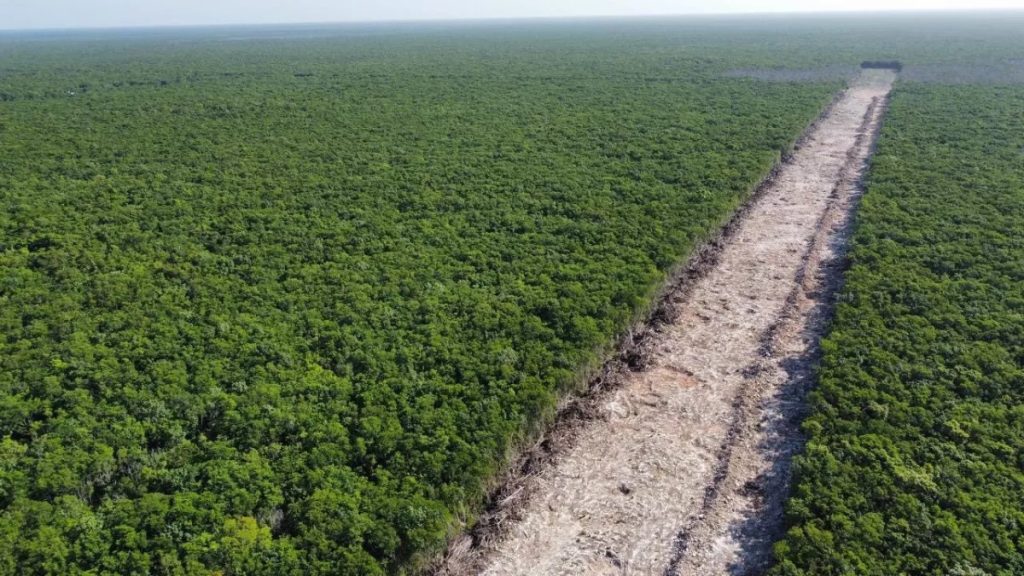
This is 100% true. Passing by certain hotel complexes in Tulum and seeing their size, it does sting a little, even if they are much smaller than those found elsewhere along the coast towards Cancun or Playa del Carmen. But once again, let’s put things into perspective for a moment. In this tropical region of the Yucatan, every new house that is built has to be constructed on jungle land. And remember, in Tulum, if you leave a garden uncultivated for two years, it will revert back to jungle.
Please do the following exercise with a minimum of good faith: Take Google Maps, activate the satellite photo option, place yourself in the center of Tulum, then zoom out to see the Yucatan. You’ll see that there is still plenty of jungle! 99.99% of the region is still well-covered. Now, do the same thing where you live, remembering that once all of Europe was covered in forests, just like the Yucatan! Today, near your home, there are probably only fields and towns left. So, ask yourself, where did you build your house?
Please do the following exercise with a minimum of good faith: Take Google Maps, activate the satellite photo option, place yourself in the center of Tulum, then zoom out to see the Yucatan. You’ll see that there is still plenty of jungle! 99.99% of the region is still well-covered. Now, do the same thing where you live, remembering that once all of Europe was covered in forests, just like the Yucatan! Today, near your home, there are probably only fields and towns left. So, ask yourself, where did you build your house?
6 "The beach is too far from the town."
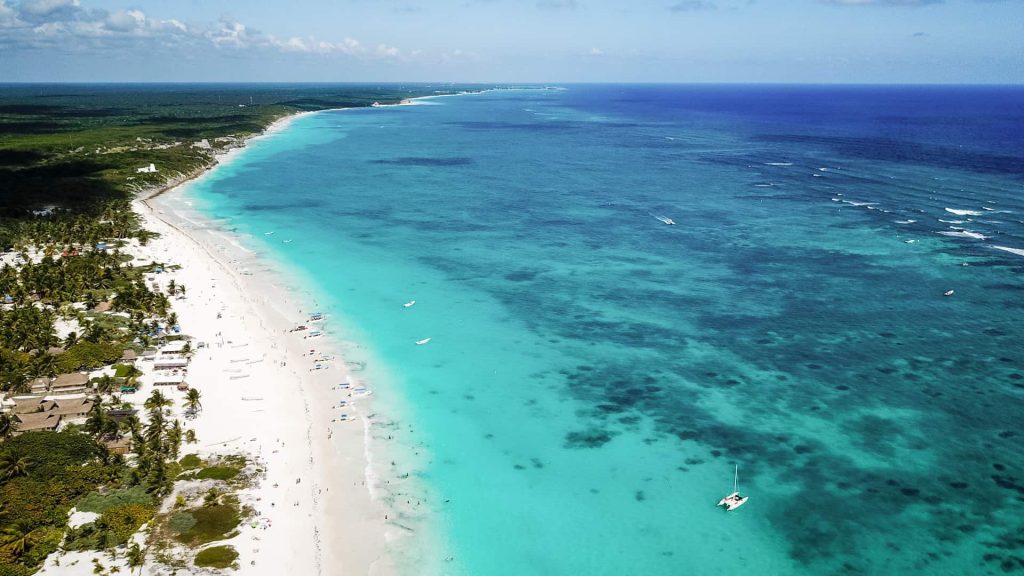
This is still true. But let’s try to understand why before we complain about it. Geologically, downtown Tulum is exactly like downtown Cancun: it’s built on solid limestone ground, rich in freshwater (cenotes). In Cancun, between downtown and the hotel zone (along the coast), there’s a large open-air lagoon. In Tulum, it’s the same—although it’s not a visible lagoon but a non-buildable marshy area. The consequence is the same: downtown areas don’t directly face the sea. Because both Cancun and Tulum have particularly spectacular beaches, urbanization was forced onto this narrow strip of sand separating the sea from the marshes. They simply paved a road and laid electrical cables, but as mentioned earlier, there isn’t even running water.
Returning to the point: it’s true that in Tulum, the beach is far from downtown, and there can even be traffic jams on the way there. Unfortunately, there are only two road accesses to cross the marsh. One in the south and one in the north. If you prefer to see the glass as half full, you won’t arrive in Tulum expecting a “downtown beach.” Compare this with the town of Playa del Carmen, for example, literally “Beach of Carmen.” You’ll find a beach truly within the town, but it lacks vegetation, so there’s no shade and it’s bordered by buildings. Moreover, the water is much less turquoise because precisely in that area, the coral reef is diverted offshore by Cozumel Island, so it’s nothing like the beaches of Tulum and Cancun.
Returning to the point: it’s true that in Tulum, the beach is far from downtown, and there can even be traffic jams on the way there. Unfortunately, there are only two road accesses to cross the marsh. One in the south and one in the north. If you prefer to see the glass as half full, you won’t arrive in Tulum expecting a “downtown beach.” Compare this with the town of Playa del Carmen, for example, literally “Beach of Carmen.” You’ll find a beach truly within the town, but it lacks vegetation, so there’s no shade and it’s bordered by buildings. Moreover, the water is much less turquoise because precisely in that area, the coral reef is diverted offshore by Cozumel Island, so it’s nothing like the beaches of Tulum and Cancun.
7 "Tulum was better before."

Indeed, it is true that Tulum has changed a lot in a very short time, specifically in just 10-15 years. Tulum’s clientele has also completely transformed. To reiterate, it’s worth mentioning that in the past, Americans went to Cancun, while European hippies backpacked their way to Tulum. Today, Tulum has embraced themes of ecology, well-being, and meditation, attracting an increasingly sophisticated clientele with significantly higher purchasing power than before. When these backpackers from the 90s, who are now in their fifties, return to Tulum, they experience a nostalgic shock. To their great surprise, they no longer find the sweet memories of their youth. Furthermore, everything has “become too expensive” for them, and they are now prohibited from staying beachfront.
8 "No access to the beaches."
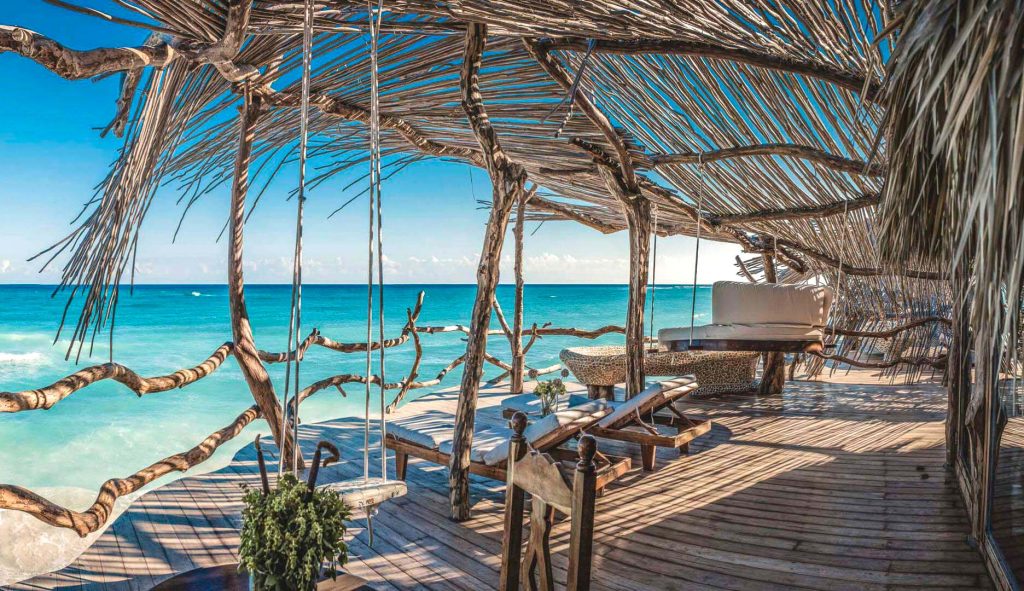
This is false. If you think this, it’s because you haven’t tried. Most hotels will allow you access. Besides, in Mexico, all beaches are public. The law requires hotels located on the coast to grant free access to people if there is no public road on either side of the private property.
However, what is true is that getting to the beach from downtown Tulum will cost you 10 euros in a taxi or 10 euros for parking. We prefer to warn you because it’s easier to swallow when you are already aware of the rates. Indeed, there is no public parking near the beaches because the marshy area we mentioned is private and non-buildable. These luxury hotels rent you access to micro-parking lots often located on the other side of the road.
However, what is true is that getting to the beach from downtown Tulum will cost you 10 euros in a taxi or 10 euros for parking. We prefer to warn you because it’s easier to swallow when you are already aware of the rates. Indeed, there is no public parking near the beaches because the marshy area we mentioned is private and non-buildable. These luxury hotels rent you access to micro-parking lots often located on the other side of the road.
9 "There are no free beaches; beach clubs are everywhere."
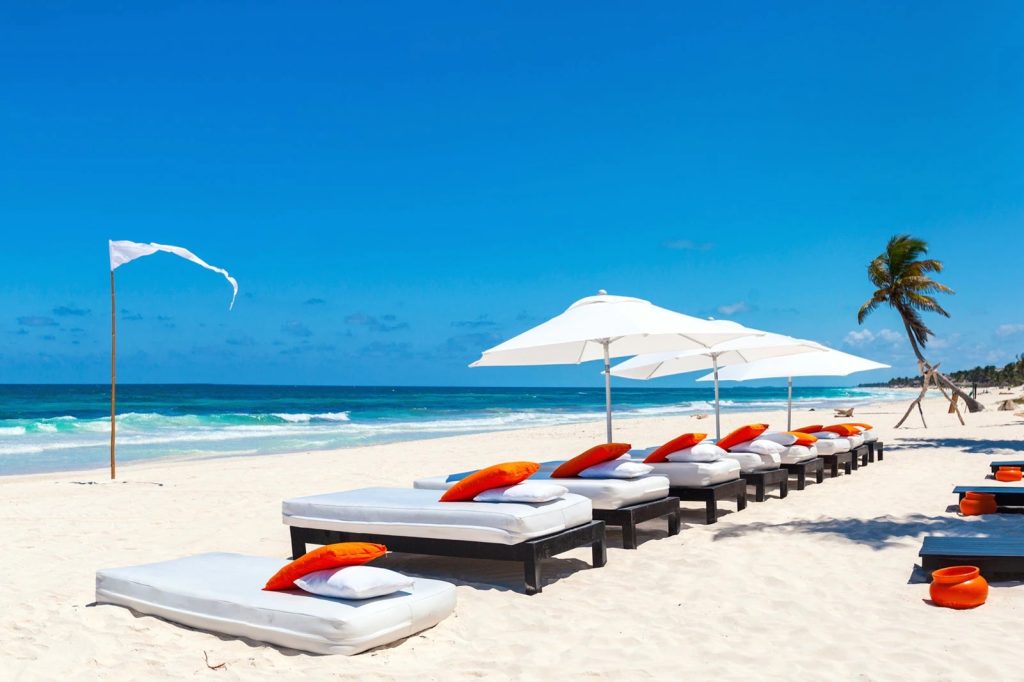
All beaches in Mexico are free, even those where numerous beach clubs and hotels in Tulum are located.
Let’s approach the problem from a different angle to better understand and resolve it. In temperate climate zones in Europe or North America, spending a day at the beach is common. A picnic, a hat, some sunscreen, and you’re all set. Most beaches don’t even have a small beach hut. This is entirely impossible in southern Mexico simply because it’s too hot, and the sun is too intense. You will need shade. And to have shade, someone needs to have thought about putting an umbrella over your head. So, you’ll have to pay for it… That’s exactly the principle behind beach clubs. Without them, the beach would be entirely impractical, and no one could even enjoy it.
If you’re not convinced, go 1 km south after the last complex in the hotel zone and pass “El Arco Maya.” This is the official boundary of the Sian Ka’an Nature Reserve, and you enter a non-buildable zone. “A non-buildable Tulum, that’s a dream,” some might say, and yet it does exist. If you go there, you’ll find that when there are no hotel installations, there are no tourists either. You’ll come across those stunning beaches that were advertised in your customized travel brochure. You’ll even take some absolutely incredible photos, but we challenge you to enjoy the beach for more than 20 minutes even with SPF 50 sunscreen because there won’t be the shadow of a coconut tree, not even that of an umbrella!
Let’s approach the problem from a different angle to better understand and resolve it. In temperate climate zones in Europe or North America, spending a day at the beach is common. A picnic, a hat, some sunscreen, and you’re all set. Most beaches don’t even have a small beach hut. This is entirely impossible in southern Mexico simply because it’s too hot, and the sun is too intense. You will need shade. And to have shade, someone needs to have thought about putting an umbrella over your head. So, you’ll have to pay for it… That’s exactly the principle behind beach clubs. Without them, the beach would be entirely impractical, and no one could even enjoy it.
If you’re not convinced, go 1 km south after the last complex in the hotel zone and pass “El Arco Maya.” This is the official boundary of the Sian Ka’an Nature Reserve, and you enter a non-buildable zone. “A non-buildable Tulum, that’s a dream,” some might say, and yet it does exist. If you go there, you’ll find that when there are no hotel installations, there are no tourists either. You’ll come across those stunning beaches that were advertised in your customized travel brochure. You’ll even take some absolutely incredible photos, but we challenge you to enjoy the beach for more than 20 minutes even with SPF 50 sunscreen because there won’t be the shadow of a coconut tree, not even that of an umbrella!
10 "In Tulum, beach clubs impose unreasonable minimum consumption requirements."
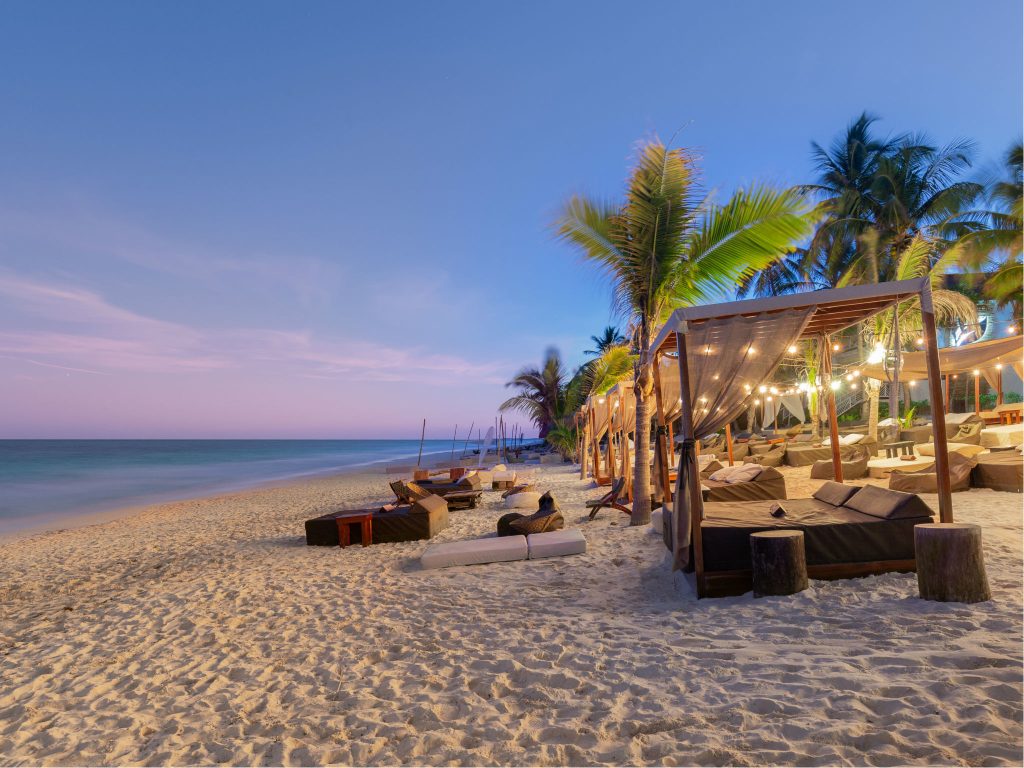
As you may have understood, beach clubs in Tulum are a necessary evil to enjoy the beach for more than 30 minutes. Still, it’s wise to inquire about the minimum consumption requirements before getting a sunbed. A minority of them do abuse these rules. Many complain and think that these minimum consumption requirements are exploitative practices akin to tourist traps. With some experience and perspective, it seems that these practices are responses to abusive behaviors from tourists themselves. Let’s try to understand: when a customer takes a spot in a beach club, it’s not exactly like sitting at a restaurant table because, in a restaurant, people usually stay for only one or two hours. At a beach club, it’s almost guaranteed that the customer will stay for at least half a day, sometimes even more—around 5-6 hours on average, as it’s the very concept of a Beach Club. Remember that Mexico is a poor country. So, if a beach club in Tulum entertains customers without imposing a minimum consumption requirement or furniture rental fee, it could go out of business in a week because it would attract all the non-solvent tourists who would spend a day there only buying a bottle of water. We hope this information might help reconcile those frustrated with beach clubs. You’re not paying a beach club just to see the sea or have access to the beach; you’re paying for someone to have prepared a nice spot in the shade because Mother Nature wouldn’t have allowed you to enjoy these wonderful landscapes otherwise. Since you have to pay a minimum consumption fee anyway, treat yourself and order food and drinks.
Conclusion
In the past 10 years, Tulum has transformed from a simple paradise beach into a town with a unique identity, offering a world of culture, originality, and surprises. Certainly, you can no longer find a seaside room for less than 400 euros a night because there are plenty of affluent tourists. However, the majority finds the concept of the town appealing.
Unrealistic expectations are almost always the cause of disappointment. So yes, those who expect to arrive in Tulum to sleep under the stars on a pristine beach, be alone in the world while visiting the Mayan ruins, and eat fresh fish morning, noon, and night for 2 euros will inevitably be disappointed. That was 30 years ago, much like everywhere else.
Today, to fully enjoy Tulum, you need to have a certain budget and come to terms with the fact that Tulum no longer exclusively means “beach and nature.” On the other hand, you will discover that the town has gained other merits: Tulum has simultaneously become a temple of well-being and meditation. It’s a monument to alternative cultures. It’s a must-visit destination for electronic and instrumental music, Latin dance, and nightlife. It’s also an exceptional place to make connections because visitors literally come from all corners of the globe, without prejudices. It’s a bubble of tolerance where no one criticizes each other, and that’s rare enough to be highlighted. Ultimately, Tulum increasingly presents itself as the temple of fusion cuisine in Mexico. You will always find a French person to serve you a crepe, an Italian to make you a pizza, and an Argentinean to grill your meat. But even more improbable, you will also find an Italian serving you a prosciutto crepe, a French chef for the 8-cheese pizza, and a vegetarian Argentinean. Tulum is a blend, it’s fusion, Tulum is an example of tolerance for others that is simply impossible to imagine in 80% of the countries around the globe. And that’s precisely why Tulum is exceptional and so widely visited.
We are reaching the end of this article in which we attempted a challenging exercise in objectivity. This is often not the case with promotional websites in the region or most travel agencies, which continue to “sell” the Tulum of the past. It’s important to note that the purpose of this effort is to shed light on some prejudices, enabling you to either better understand Tulum in 2024 or, conversely, remove it from your itinerary. In both cases, we hope to have a positive impact on your journey.
Unrealistic expectations are almost always the cause of disappointment. So yes, those who expect to arrive in Tulum to sleep under the stars on a pristine beach, be alone in the world while visiting the Mayan ruins, and eat fresh fish morning, noon, and night for 2 euros will inevitably be disappointed. That was 30 years ago, much like everywhere else.
Today, to fully enjoy Tulum, you need to have a certain budget and come to terms with the fact that Tulum no longer exclusively means “beach and nature.” On the other hand, you will discover that the town has gained other merits: Tulum has simultaneously become a temple of well-being and meditation. It’s a monument to alternative cultures. It’s a must-visit destination for electronic and instrumental music, Latin dance, and nightlife. It’s also an exceptional place to make connections because visitors literally come from all corners of the globe, without prejudices. It’s a bubble of tolerance where no one criticizes each other, and that’s rare enough to be highlighted. Ultimately, Tulum increasingly presents itself as the temple of fusion cuisine in Mexico. You will always find a French person to serve you a crepe, an Italian to make you a pizza, and an Argentinean to grill your meat. But even more improbable, you will also find an Italian serving you a prosciutto crepe, a French chef for the 8-cheese pizza, and a vegetarian Argentinean. Tulum is a blend, it’s fusion, Tulum is an example of tolerance for others that is simply impossible to imagine in 80% of the countries around the globe. And that’s precisely why Tulum is exceptional and so widely visited.
We are reaching the end of this article in which we attempted a challenging exercise in objectivity. This is often not the case with promotional websites in the region or most travel agencies, which continue to “sell” the Tulum of the past. It’s important to note that the purpose of this effort is to shed light on some prejudices, enabling you to either better understand Tulum in 2024 or, conversely, remove it from your itinerary. In both cases, we hope to have a positive impact on your journey.
Very basic tips for visiting Tulum
Choose a nice accommodation with a pool (it gets very hot), rent a car, and most importantly, arrive without preconceptions to discover the wonders of the town. You are free to prefer getting lost to find them on your own or, on the contrary, plan everything to not miss a thing. If it’s the latter, feel free to continue your readings in our “What to Do in Tulum” section where you’ll find plenty of great suggestions. And when you go to the beach, please choose a beach club you like and stay there all day; it’s just divine. It will prevent you from getting sunburned in an hour, which could spoil the rest of your trip.